Homeowners looking to cut back on costs by growing their own food face a dilemma- how do you build a garden for yourself and maintain curb appeal?
In the past three years we’ve seen the property prices in Hamilton skyrocket- to almost unbearable levels. If you bought your home and need to keep your costs down to pay that mortgage growing food could be a solution- if you can find the room. If you’re lucky enough to have bought into the market at the right time you could be sitting on a goldmine if you want to sell, but you’ll need to keep the view of your home looking welcoming and desirable.
My goal of gardening in homesteading is to be self-reliant for food production. My goal as an urban gardener is to cut back on food costs and create habitat for pollinators. For my goals, the best method of garden design is based on permaculture theory- but sometimes these gardens look like a hot mess.
In short, permaculture is the development of agricultural ecosystems intended to be sustainable and self-sufficient. In theory by designing your garden so your foods and flowers work together as a system will cut back on waste, and effort, and lead to potentially greater yields from your garden as a result of bringing in pollinators and other beneficial wildlife to your food plants.
We’ve seen a terrifying decline in bees and other local pollinators in the past three years, and in terms of food production, this doesn’t bode well for humans. Pollinators are responsible for one in three bites of food you take, so it’s pretty vital that we find ways to support them- especially as residents of urban areas where pollinator populations actually thrive better than in rural environments.
Of course, the type of gardens and landscapes that can offer food to us and the bees, and provide habitat for wildlife are not easily commercially appealing. They can often look untidy, overgrown, or high-maintenance- all things that will kill your curb appeal. Our heavy insistence on landscaped yards and gardens that offer no purchase to necessary wildlife, and do very little for us also, is terribly detrimental. Building a landscape that one can live in is not only beneficial to the environment, it is beneficial to our health, and can be artfully done so as to be beneficial to our homes worth as well.
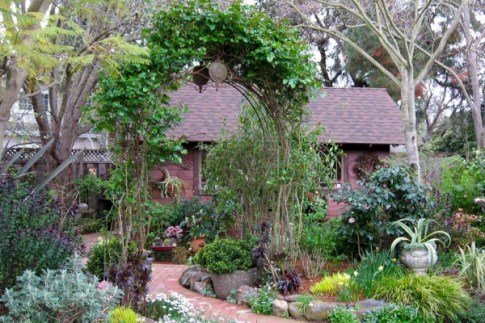 For example, this design utilizes several different fruit trees and shrubs as it’s base or inspiration, and works other beneficial plants into the mix, while keeping a beautiful aesthetic that wouldn’t you just love to walk around in?
This type of gardening takes time and effort to envision, plan, and implement. However the major payoff is not just the ecological benefits, but that with the effort put in initially a gardener is afforded less time, resources, and effort later. That really appealed to me.
So I’ve begun my garden planning with this in mind, and will share the planning process in my next post.
Building an edible landscape, or ecological gardening is not traditional, but it does bring the neighbours out to talk! It takes getting used to (I’ll have to keep my eye out for squirrels in my strawberries & onions), and each garden must be unique to its environment- I put in an apple tree to mirror a neighbours garden- but all gardens are unique to their creators. And that’s as it should be.
We can move beyond our lawns and see our urban landscapes as malleable and promising, to evaluate how we can save the world with our front & backyards. As homeowners, we can benefit from ecological gardening now, and again, (and again, and again) by building an edible landscape that attracts future buyers and still looks good. We continue to see houses as good investments, no matter how high the prices rise. Taking care to invest wisely is a smart idea. We also recognize our environment is of utmost importance – more so than affordable housing according to a recent survey of millennials – the more we can do the better. There is a way to marry our financial needs with our ecological responsibility, we just have to de-pave the way.
Check in next week for an overview of a planning process to get your garden started!
 Hedgerow Farm Studio