Hamilton’s downtown used to be underwater and as a result, we have a specific type of soil that shows up everywhere- clay. Heavy, grey, impossible-to-get-your-foot-out-of-after-a-heavy-rain, no-good-for-growing-anything clay soil. If you want to grow here, you’ve gotta fix it, and permaculture can offer us the way.
In the seven years I’ve lived in my current house, the constant in all my attempts to make the garden beautiful and productive has been a) stubbornness b) accidental neglect, and c) trying to work with the damned clay soil.
Enter my most recent mindblowing discovery – Permaculture. I recently started reading Gaia’s Garden by Toby Hemenway, which, as I understand it is the seminal book on permaculture theory & techniques. The thing that grabbed my attention is that permaculture uses ecology for practical gardening. The core idea behind these techniques is to design our landscapes to mimic nature, which takes care of itself, allowing for less labour, resources, and time needed for us to take care of our gardens AND treats the soil as a living thing that needs to be taken care of just as our plants do. Permaculture offers us strategic, long-term techniques to repair the earth we live on for growing. Perfect.
Nature, according to permaculture theory, will grow into a forest when left to its own devices. So when designing according to these techniques we mimic the seven layers of a forest: the high tree layer, low tree layer, vine layer, shrub layer, herbaceous layer, groundcover, and root layer. There are potentially other layers depending on where you read, such as a swamp layer and fungal layer.
Taking these into account, and too excited to plan correctly, I of course immediately bought an apple tree.
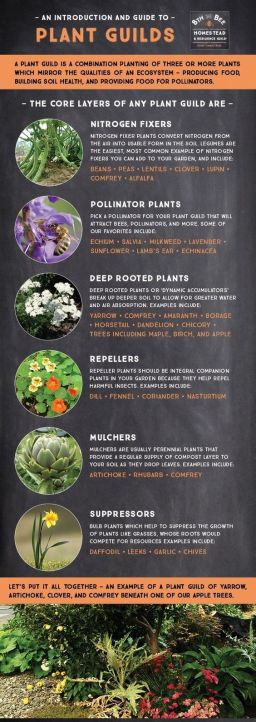
The next aspect of growing according to permaculture involves pairing plants to form guilds. If you’re familiar with companion planting you’ll know that some plants work well with others. Think the “three sisters” of squash, beans, and corn. Each plant gives and receives something from its companions, forming a web of interdependence. When piecing together your own guilds it’s important to take into account what plants do- for each other, and for the soil.
There are six essential roles plants of any layer can perform. They can suppress unwanted plant growth, attract beneficial insects or wildlife, repel detrimental insects, wildlife, or conditions, provide mulch by dropping leaves, accumulate nutrients such as calcium, potassium, and sulfur in the soil with deep roots, or fix the nitrogen levels in the soil. All of these roles allow our plants to gradually form a forest eco-system while breaking improving the quality of the soil that forest stands on.
So I’ve started doing my darnedest to create a guild around my apple tree and create an edible forest in my front yard.
With any luck by next year we’ll be harvesting apples as we walk in the front door after the first few days of school, and we’ll be improving the soil for our next round of planting. Perfect!
 Hedgerow Farm Studio
One thought on “Starting a permaculture forest.”