When I look at images of my dream life, it’s pretty simple. But sometimes it changes. Let’s be real – we are multi-faceted people and our dreams can change. Sometimes on the daily. That’s ok. What we’re going to do here is analyze what goes into your dreams, and what you can take out of them.
In my dreams of a simple sun soaked country home surrounded by flowers and calm, happy children I’m calm and patient and almost carefree. My stress is gone because my goals are simple – garden, cook, eat, smile.
That’s like, maybe what I’ll be like in retirement. Or, never.
I know I just said outline your dream life la la la. Did you do that? Yes? Great. No? Do it. When I look at mine I see that a) I’d like less stress in my life. b) I’d like to be more present for the people I love, c) I’d like to be a source of joy and calm for them, and d) I’ve identified fresh food and time spent outside with a purpose as important to me.
Great. When you made your picture of a dream life what did it tell you about a) the things, people, feelings, or activities that are NOT important to you? b) who you want to be – your character values c) what you want people to feel around you. d) the things, people, feelings or activities that ARE important to you?
If you’re on a homesteading blog, it’s likely something that is important to you is food, sustainability or environmental consciousness, self sufficiency, or you’ve romanticized what pastoral life is like and also want to live in the french countryside with your long wavy hair tied back with flowers while you walk barefoot from milking a cow to fresh bread coming out of the oven and a warm breeze coming through open windows to your ancient woods filled kitchen.
This blog will help with the first three things on that list. For the last I recommend watching more fairytales. We’re going to focus focus focus, and make our goals really specific by extrapolating what’s important – giving it a timeline – and making it measurable.
Turning Ideas Into Actions
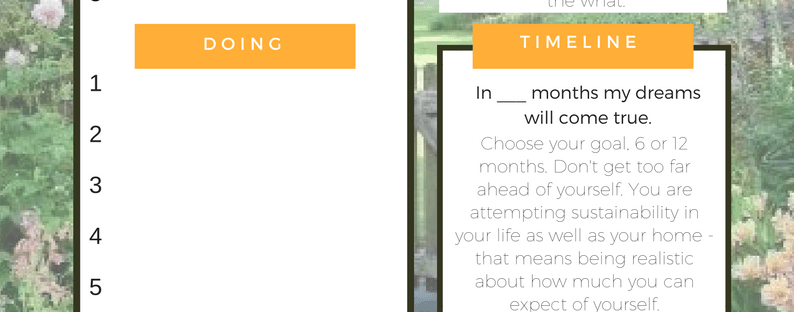
- Set your timeline. In Tim Feriss’ book The 4 Hour Workweek he outlines how to create a dream timeline or “dreamline.” Regardless of how you feel about his books or ego, the dreamline is a free tool, and it’s great*. Because we’re in South Ontario we’re going to work in 3 month periods (roughly what our seasons are).
- Outline your goals. Let’s identify exactly what you want to have, who you want to be, and what you want to do. I’m applying these to homesteading and sustainability. Try to list 3-5 ideas for each category. Then – Pick 3. Not 3 of each category, just your 3 most important ones. What ideas if you make them reality will make the biggest difference in your life in 3 months?
- Use BestSelf Co.’s 13-Week Roadmap to identify how you’re going to achieve these things. I’m hoping at least one of your results goals will be related to homesteading and sustainability, but if you find out you’ve got other stuff on your mind – that’s great – work on that. Fill up your cup, come back if it’s best for you. Keeping in mind if your goal is getting healthy – working outside and eating fresh food will help. If it’s paying down the credit card bill – growing your own food or auditing your energy usage will help too! If it’s learning Cantonese…maybe you can grow bok choy? Living Sustainability is related to almost all things, that’s part of its beauty.
- Start.
I’m going to share what this looks like for my goals. And if you’d like to follow along with 1 or all of them, I’ll provide the tools I’ve found along the way – and we’ll all create a community of support to enable each of us to achieve these goals.
Download your Sustainable Homestead Dreamline here!
*The sample Dreamlines in the .pdf include how to cost out what your “Target Daily Income” is – if you’re interested in learning more about this The 4 Hour Work Week is available on audible, amazon, or, your local library. I’m just using this as a guide for now.
 Hedgerow Farm Studio